
Mental Maths, Truth Tables and Making Partnership Choices: Part 4
In Parts 1–3, I used simple logical concepts to ask wider questions about partnerships: what does the problem require and what does each organisation bring; what is the partnership part of; and how do relationships and influence work across the system?
Part 4 brings those ideas into one picture. Here, I use Set theory to ask a simple question: what belongs where?
From combinations to structure
Truth tables help us examine combinations: who has a capability, who does not, and what happens when capabilities are brought together. Set theory lets us see what each organisation has, where capabilities overlap, and what remains missing.
Imagine an NHS organisation and a cancer charity working to improve access to cancer diagnosis for ethnically diverse communities. Both come with their collection of useful assets
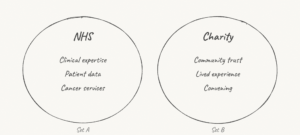
A = NHS capabilities [service data, clinical expertise, referral-pathway knowledge, local pathway authority, communications]
B = Charity capabilities [community relationships, lived-experience insight, convening, communications]
Intersection and union
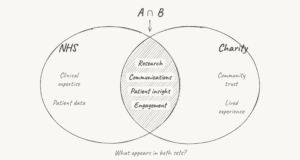
Now, when you look at both organisations as one, you have some intersection. The intersection, A ∩ B, contains what both organisations have. The overlap may create duplication, reinforce work, or mean neither side needs to rebuild an existing capability.
Then, we have the Union. The union, A ∪ B, contains everything either organisation brings: data, clinical and pathway expertise, local authority, community relationships, lived insight, convening and communications.
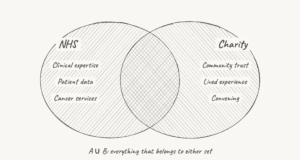
But is that enough to change the problem? Not necessarily so, as having more capabilities does not mean the problem is solved.
Finding the gap
Suppose the capabilities required to improve access are:
R = [referral-pathway knowledge, pathway authority, community trust, relevant service data, commissioning influence]
Most are covered by A ∪ B, but commissioning influence is missing:
R \ (A ∪ B) = [commissioning influence]
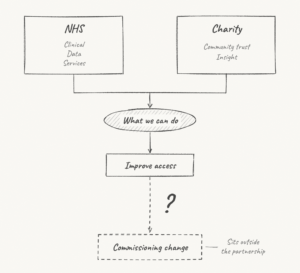
In plain English, one requirement sits outside the partnership. The partners may understand the problem, improve information and work with communities, yet be unable to change a pathway constrained by commissioning arrangements.
The gap helps define the next move: bring in another organisation, extend an existing partner’s role, or acknowledge that the problem requires wider system change.
Outside the partnership, but inside what?
The universal set, U, is the wider collection of capabilities and influences relevant to the problem. The complement, U \ (A ∪ B), represents what is important but sits outside the partnership, such as commissioning influence, primary-care incentives, information governance or workforce capacity.
Pay attention to the boundary: “Outside” could mean outside the two organisations, the project, the local health system or the wider health and care system. Each boundary reveals different things.
This links back to Part 2: the partnership is one set within a larger system. The aim is not to include everything, but enough of the relevant system to support a better decision.
What is actually relevant?
A subset is part of a larger set. An organisation may have dozens of capabilities, but only a few may matter to a particular outcome. Partnership design becomes sharper when we identify what the problem requires, rather than treating the whole organisation as relevant.
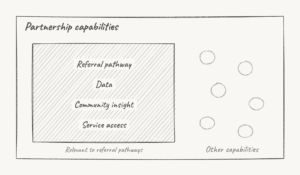
The empty set, ∅, helps describe a specific gap. If commissioning influence is required and neither partner has it, the overlap between that requirement and the partnership’s capabilities is empty. The partnership can still bring value but one important requirement remains uncovered.
Making the structure visible
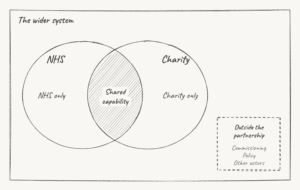
A Venn diagram gives partners something concrete to question: Does this capability really belong here? Who holds it? Is it essential? What sits outside our influence?
Across the series, each mathematical idea offers a different view. Truth tables examine combinations; set theory makes membership, overlap, coverage and gaps visible; relational thinking examines influence and dependency; systems thinking keeps the wider environment in view.
The central lesson is that the partnership may not be the right unit of analysis. Two organisations can work well together and still fail to achieve an outcome because another part of the system controls a crucial condition.
So ask: What does this partnership contain, what does it leave outside, and can it influence the conditions needed to change the problem?
The point of doing this is to make assumptions visible and challengeable, so we can decide what needs to happen next.
I’ll be teaching a lot on these at the one day workshop on Systems Thinking for Strategic Partnerships and Convening. You can find more information here