
Bami speaks to the Health Ministry Delegation at the University of Cambrigde.
Beyond Government: Charity-Led Cancer Care Models and What They Mean for LMICs
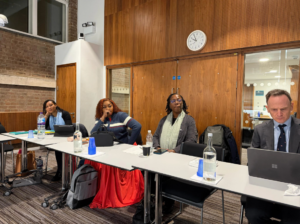
Last week I presented to Nigeria’s Federal Ministry of Health delegation at the University of Cambridge, including the Minister of State for Health. The event was part of the Strengthening Cancer Systems Together: Cambridge-Nigeria Partnership, and the brief was specific: speak on charity-led intervention models and their potential application to Nigeria’s cancer care landscape.
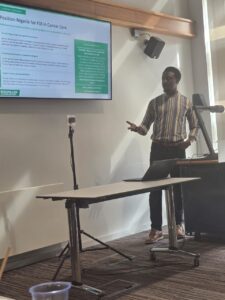
The presentation was titled “Beyond Government: Charity-Led Intervention Models and Partnerships That Drive Cancer Care.” The premise is deceptively simple: in high-performing health systems, charities do not replace government, they operate as connective tissue between medical treatment and the broader infrastructure patients need to navigate a cancer diagnosis.
What became clear in the conversations that followed is that Nigeria is not looking to import blueprints. The country has world-class clinicians and a National Cancer Control Plan already in motion. The opportunity is not to solve deficits but to accelerate what exists through structured partnerships that unlock additional capacity.

The Model: Not Aid, But Architecture
Across functioning health systems, charities contribute capabilities that government cannot easily replicate: patient navigation networks, clinical workforce seeding, blended finance vehicles, corporate partnership infrastructure, and community-based delivery models. These are not peripheral activities. They are structural components of care delivery.
The distinction matters. When charities operate as partners rather than gap-fillers, they introduce new capital, new expertise, and new delivery mechanisms into the system. The question is not whether charities should be involved, they already are. The question is whether that involvement is structured, accountable, and integrated with public infrastructure, or fragmented and opportunistic.
Nigeria has an active NGO sector working in cancer care. What it lacks is the policy architecture that turns distributed activity into coordinated capacity. That architecture can be built.
Five Structural Interventions
I offered five recommendations drawn from global partnership models. These are not prescriptive solutions but entry points for multisectoral collaboration.
1. Create a Cancer Partnerships Policy Framework
Nigeria’s existing National Strategic Cancer Control Plan provides a strong foundation. A formal Cancer Partnerships Lab would operationalise it by defining how government, NGOs, pharmaceutical companies, corporate actors, and global agencies collaborate on cancer care, with clear accountability, funding pathways, and reporting standards.
This is not administrative bureaucracy, it is market infrastructure. Official government recognition unlocks doors to philanthropy, corporate partnerships, and international funders. In systems where power is concentrated centrally, formal backing becomes a signal that structures capital flows and legitimises sectoral collaboration.
2. Pilot a Diagnosis-to-Support Pathway
At the point of cancer diagnosis, patients could be automatically signposted to verified NGOs, helplines, and financial guidance through a digital system. This turns fragmented charity activity into structured care journeys, ensuring that support reaches patients at the moment they need it most, not through luck or personal networks, but through system design.
Nigeria and other LMICs do not need to replicate the technology stack from developed economies; they need to pilot the principle using existing digital health infrastructure and NGO networks.
3. Mobilise Philanthropic Capital Through a Federated Vehicle
Nigeria ranks first globally in the World Giving Report 2025. Nigerian philanthropists have contributed $434 million over the past five years. The constraint is not appetite, it is infrastructure.
A federated giving vehicle that pools family foundation capital, corporate contributions, and diaspora wealth into a single cancer impact fund creates both scale and accountability. Philanthropists follow evidence. NGOs that produce rigorous outcome data attract more capital. Government can incentivise this reporting through tax structures, visibility, and formal partnerships that make impact transparent and trackable.
The Nigerian diaspora in the UK, US, and Canada represents a significant and underutilised funding channel. Health-focused diaspora impact funds can be structured to bridge expat networks with on-ground delivery, turning remittance flows into structured health investment.
4. Position Pharma as Community Care Partners
Pharmaceutical companies already operate in Nigeria. The question is whether they function as genuine partners in community care or solely as market participants.
Three partnership models warrant piloting: co-funding patient navigation roles within hospital oncology units, supporting NGO-led clinical trial recruitment in local communities, and backing screening and education drives in underserved areas. Each model positions pharma not as a vendor but as a stakeholder in care delivery.
5. Build the FDI Enabling Environment for Cancer Care
Aid follows need. Investment follows positioning. Nigeria and other LMICs must decide which they are playing for.
The country has a compelling narrative: world-class clinicians in diaspora, a young and diverse population, philanthropic capital, and policy leadership willing to convene multisectoral conversations. An enabling environment; data governance frameworks, IP protection, clear repatriation rules turns that narrative into structured capital flows.
We are entering an intelligence age where AI, genomics, and data-driven medicine will reorder global healthcare. To benefit, Nigeria needs infrastructure: cloud systems, research capability, regulatory clarity. Healthcare is the right place to start. Sector-specific impact labs and global health investors are actively seeking frontier markets. An enabling policy environment can attract them to the country.
The positioning play is deliberate: Nigeria as an expat-led affordable care hub, where diaspora clinicians can maintain dual practice through digital consultations and periodic rotations. This is not aspiration, it is strategy.
What Stayed with Me
The appetite in the room was genuine. Nigeria’s health leadership is thinking beyond traditional donor models toward partnerships that leverage local strengths, diaspora expertise, and private capital. The conversations were not about importing solutions but about adapting principles to Nigerian realities.
What charity-led models offer is not a replacement for government investment but a structured way to unlock additional capacity (clinical workforce, patient navigation, blended finance, corporate partnerships) that accelerates systems change without waiting for public budgets to expand.
The constraint is not vision or willingness. It is the architecture connecting intent to execution: partnership frameworks, capital vehicles, policy enablers that turn fragmented activity into structured capacity.
The question now is implementation. Nigeria has the ingredients. The next step is building the infrastructure that turns potential into performance.